


Manchester City
Explore Man City FC founding history, Etihad Stadium, Premier League records and match day guides. The hub for every Manchester City fan.
Few clubs in English football have moved between obscurity and dominance as dramatically as Manchester City. From a church cricket club in east Manchester, to a famous 1998 relegation to the third tier of English football, to the Abu Dhabi-funded force that has redrawn the Premier League's honours boards over the last decade and a half. City's story is one of the most complete transformations in the modern game. Genuine Manchester City tickets are in permanent demand, and that demand only intensifies around the club's biggest fixtures, cup runs, and derby weekends.
The Founding Era: St. Mark's to the Etihad
From a Church Cricket Club to Ardwick AFC
Manchester City's roots trace back to 1880, when members of St. Mark's (West Gorton) Church cricket club formed a football team to keep players fit over winter. The club became Ardwick Association Football Club in 1887, before adopting the Manchester City name in 1894 following its move to Hyde Road. The club's first major honour arrived in 1904, when City lifted the FA Cup.
Third Division Despair, Wembley Redemption
City spent much of the twentieth century swinging between promotion and relegation, but nothing defined the club's reputation for unpredictability quite like 1998, when City were relegated to the third tier of English football for the only time in the club's history. The following season ended in redemption: a dramatic play-off final at Wembley against Gillingham, in which City came back from 2-0 down in stoppage time to win on penalties and secure an immediate return up the divisions, a result still cited as one of the great comebacks in English football folklore.
The Premier League Era: Evolution & Data
The Abu Dhabi Takeover (2008–Present)
Manchester City's modern era began in September 2008, when the Abu Dhabi United Group, led by Sheikh Mansour bin Zayed Al Nahyan, completed its takeover of the club. The investment transformed City almost overnight from a mid-table Premier League side into direct rivals for the league's biggest prizes, prompting City's neighbours to famously brand them "the noisy neighbours." The club's first Premier League title followed in 2011–12, sealed in the final minute of the final day of the season, still one of the greatest title deciders the premier league has witnessed.
The Guardiola Legacy and the 2023 Treble
Pep Guardiola's appointment in 2016 accelerated City's evolution from a well-funded contender into the Premier League's defining team of the era. Under Guardiola, City won the Premier League in 2017–18, 2018–19, 2020–21, 2021–22, 2022–23, and 2023–24; including a first-ever run of four consecutive English top-flight titles. The high point came in 2022–23, when City completed the treble of Premier League, FA Cup, and UEFA Champions League, beating Inter Milan 1-0 in Istanbul to win the club's first Champions League. A FIFA Club World Cup followed that December, completing a clean sweep of every trophy available to the club in a single calendar year.
The seasons since have been more turbulent by City's own recent standards. An early season-ending injury to midfielder Rodri in 2024–25 coincided with the end of City's four-year title stranglehold, and the following months brought further reminders that the Guardiola era's next chapter would be less straightforward than the one before it — including a shock Club World Cup exit to Saudi side Al-Hilal in 2025. The club has used the transfer windows since to reshape an ageing core, refreshing the squad around long-serving names as it works to re-establish itself at the top of the table.
The Blueprint: Tactical Identity Under Pep Guardiola
Positional Play and the Inverted Full-Back
Guardiola's City is built on positional play: rigid structural discipline in possession designed to create passing lanes and numerical overloads in specific zones, rather than free-flowing improvisation. The clearest signature of this approach has been the inverted full-back — a defender who tucks into central midfield in possession rather than staying wide — a role popularised at City by players like Joao Cancelo and continued through the current squad, giving City extra central control while full-backs elsewhere are pushing forward.
Donnarumma to Haaland: A Model Built End to End
The system depends on control starting with the goalkeeper: Donnarumma’s distribution effectively functions as an auxiliary outfield passer, allowing City to build attacks from deep under pressure. At the other end, Erling Haaland's arrival in 2022 gave Man City something earlier City sides lacked, a clinical goalscorer.
The 2026/27 Season: What to Watch
Maresca takes over from Pep from the 2026/27 season. Pep's dominance had to end one day and now that he's stepped away, Maresca has one of the toughest acts to follow.
Ownership & Finance
City Football Group: A Global Club Network
Manchester City sits at the centre of City Football Group (CFG), one of football's largest multi-club ownership networks. Abu Dhabi United Group holds the controlling stake in CFG, alongside minority investors including US private equity firm Silver Lake and a Chinese investor consortium. CFG's portfolio extends across multiple continents, including New York City FC, Girona FC, Melbourne City, Mumbai City, and a stake in Yokohama F. Marinos — a network built to share scouting, data, and playing philosophy across clubs.
The 115 Charges: Where the Financial Fair Play Case Stands
In February 2023, the Premier League charged Manchester City with 115 alleged breaches of its financial rules spanning 2009 to 2018, covering areas including manager and player remuneration disclosure and profitability rules. An independent commission hearing into the charges ran through much of 2024 and 2025. As of the most recent reporting, the panel's full written verdict has not been made public, and the case remains one of the most consequential pending rulings in English football.
Etihad Stadium: The North Stand Expansion
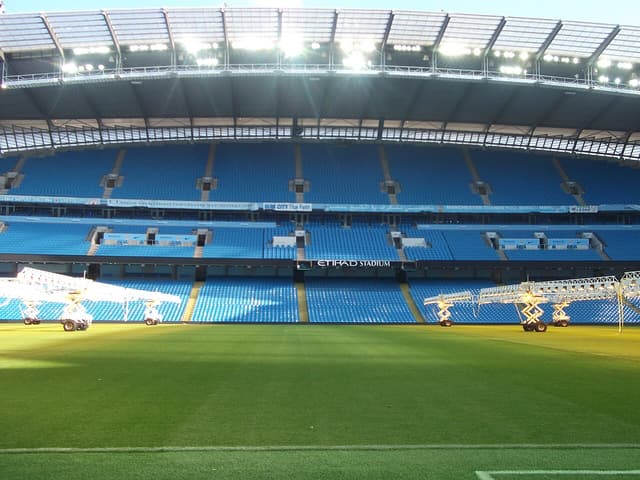
Etihad Stadium opened in 2003 as the City of Manchester Stadium, built for the 2002 Commonwealth Games before being converted for football and taking on its current name under a sponsorship deal with Etihad Airways in 2011. The stadium sits at the centre of the wider Etihad Campus, which also includes the City Football Academy. A major redevelopment of the stadium's North Stand, adding a new upper tier and pushing capacity toward roughly 61,000, has been under way as part of the club's push to close the gap on English football's largest grounds.
Behind the Etihad Stadium: Club Secrets & Internal Mechanics
Recruitment and squad planning at City run through a data-led model overseen by the club's football leadership, leaning on the scouting and analytics infrastructure shared across the wider City Football Group network to identify talent before it becomes obvious to competitors. The City Football Academy, opened in 2014 at a cost of roughly £200 million, sits directly beside the Etihad and houses the club's first team and academy operations under one roof, a deliberate design intended to keep every age group working inside the same tactical framework Guardiola's first team plays.
Manchester City Honours & Club Success
English top-flight titles: 10 (1936/37, 1967/68; Premier League 2011/12, 2013/14, 2017/18, 2018/19, 2020/21, 2021/22, 2022/23, 2023/24)
FA Cup: 7 (1904, 1934, 1956, 1969, 2011, 2019, 2023)
EFL/League Cup: 8 (1970, 1976, 2014, 2016, 2018, 2019, 2020, 2021)
UEFA Champions League: 1 (2023)
UEFA Cup Winners' Cup: 1 (1970)
FIFA Club World Cup: 1 (2023)
FA Community Shield: Multiple wins across the club's history, most recently in 2019 and 2021
The 2022–23 treble made City only the second English men's club, after Manchester United in 1999, to win the Premier League, FA Cup, and Champions League in the same season.
What Does the Manchester City Badge Mean?
Manchester City's current circular badge carries three diagonal bands representing the city's three rivers the Irwell, the Irk, and the Medlock — a golden ship symbolising Manchester's industrial and trading heritage via the Manchester Ship Canal, and a red rose reflecting the club's Lancashire roots. The design deliberately echoes the club's circular badge from the early 1970s, reintroduced in 2016 in place of the shield-and-eagle crest used through the 1997–2015 period.
Manchester City Tickets: Prices, Allocation & How to Buy
Manchester City tickets run through the club's tiered Cityzens membership system. Official, Matchday, and Junior, with only Matchday and Junior members getting priority access when fixtures go on sale. For the 2026/27 season, adult General Admission prices at official release sit roughly in the £20–£60 range depending on the opponent and category, with under-18 tickets between £10 and £30; Champions League and marquee fixtures are priced and released separately from the standard league bands. A Ticket Exchange lets Season Ticket Members resell a seat for a game they can't attend, though the buying side is restricted to Matchday and Junior members, not the general public.
Away tickets are the hardest category for any club's fans, City's included allocations at most Premier League grounds are limited and typically distributed to Season Ticket Members by loyalty points before anyone else is considered, and away ticket prices across the league are capped under the Premier League's long-standing flat-fee agreement. For domestic cup finals and the Community Shield, each club's allocation is a fixed slice of the stadium's roughly 90,000 capacity, which is why City tickets for an FA Cup Final at Wembley or a Community Shield fixture tend to move fastest of all.
Fixture congestion around December and January; Boxing Day, New Year's fixtures, and the FA Cup third round is typically when general sale windows open widest, since squad rotation and midweek scheduling reduce demand relative to marquee weekend games. A Cityzens ticketing account is required to buy directly from the club and receive on-sale notification emails; fans without one, or without Matchday/Junior status, are functionally locked out of the club's own priority windows regardless of what's discussed in Reddit threads like r/MCFC about workarounds.
For the full breakdown of how non-members can buy Man City general sale tickets see Love1Ticket's guide to buying Man City tickets without a membership.
To compare live prices by fixture rather than face-value estimates, browse Manchester City tickets on Love1Ticket
Browse verified Manchester City tickets on Love1Ticket, every seat backed by our FanPromise 100% Buyer Protection guarantee.